
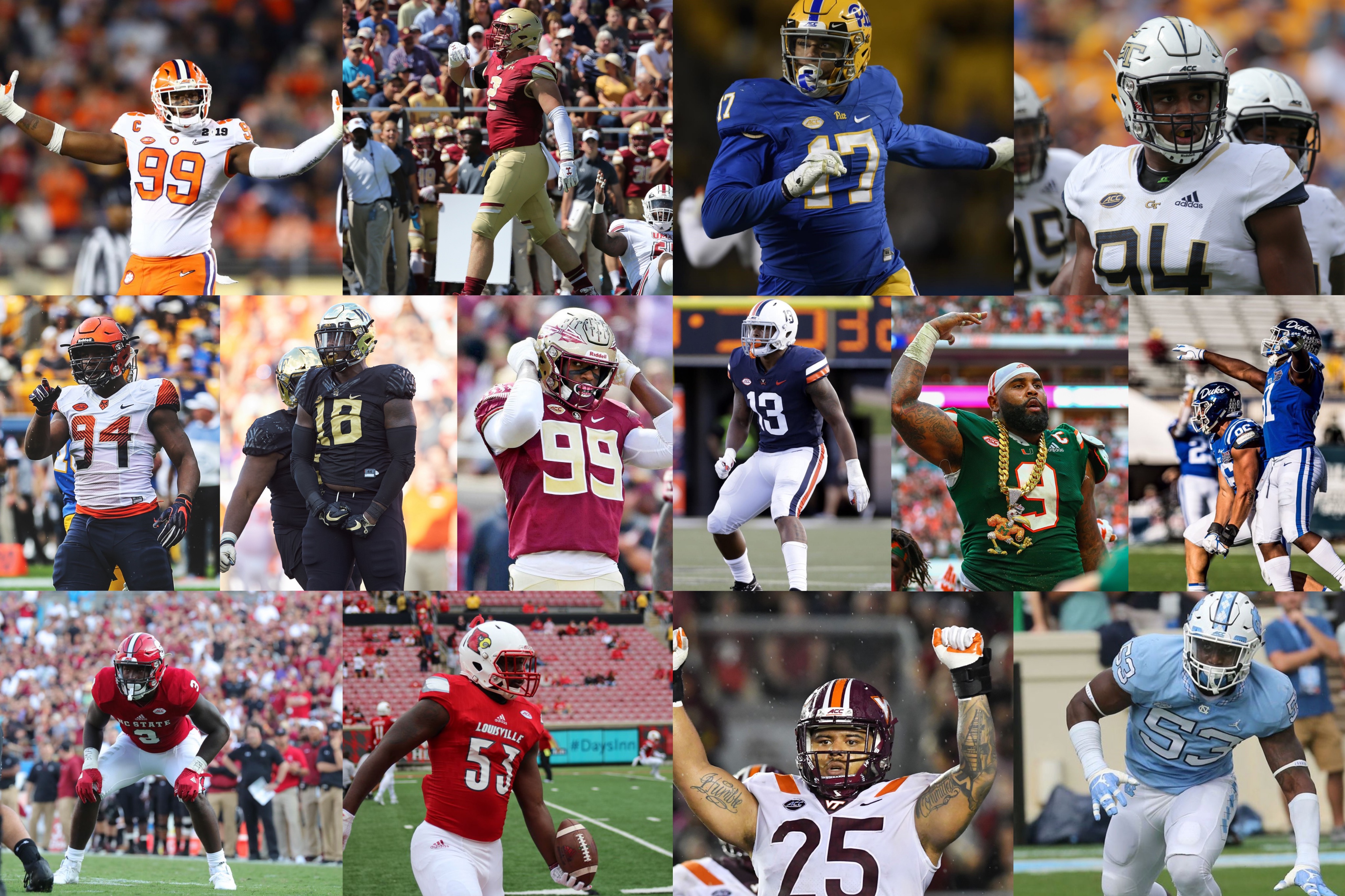
Leaders in Tackle for Loss per team in 2018
The ACC is home to the 2018 ACC and National Champions, the Clemson Tigers. In the 2018 season, two ACC teams finished in the top 25, Clemson (1) and Syracuse (15). Here are our predictions for the 14 ACC teams’ 2019 season:
The ACC Atlantic:
The ACC Atlantic division is home to Boston College, Clemson, Florida State, Louisville, NC State, Syracuse, and Wake Forest. Below, you can find some of the team and individual statistics from each team, as well as what you can expect from them in the 2019 season.
Boston College: The Eagles finished the 2018 season with a 7-5 record, going 4-4 in the ACC. Scoring 384 points, BC’s offense averaged 16.3 completions on 28.1 attempts for 215.3 yards in the air, and 189.2 yards in 46.4 attempts per game in the 2018 season. On 285 attempts, quarterback Anthony Brown threw 158 completions for 20 touchdowns, 2121 yards, and 9 interceptions. Leading the team in receiving, Kobay White and Tommy Sweeney combined for 874 yards on 65 receptions, scoring 6 combined touchdowns. Boston College’s running back, AJ Dillon lead the team in rushing with 1108 yards on 227 attempts, scoring 10 touchdowns for the eagles, while Ben Glines rushed for 380 yards on 68 attempts, scoring 3 touchdowns. Surrendering 308 points in the 2018 season, it is obvious that the eagle’s defense needs some work. BC’s defense was able to force a total of 26 turnovers, 18 interceptions (Hamp Cheevers lead the team with 7, one lead to a pick six) and 8 fumble recoveries (William Harris and Zach Allen lead the team with 2). For Boston College to have a more successful 2019 season, the eagles will not only need to find a way to score more points, but a way to stop their opponent from scoring. BC’s offense only was able to score 76 more points total than the defense was able to prevent.
Roster: https://bceagles.com/roster.aspx?path=football
Schedule: https://bceagles.com/schedule.aspx?path=football
Clemson University: With a perfect 15-0 season: The Cotton Bowl Champions (beat Notre Dame 30-3) and The 2018-2019 National Champions; defeating Alabama by a score of 44-16. Scoring a total of 664 points, it’s safe to say that the tigers had one of the most dominating and effective offenses in the 2018 season. Clemson attempted 33.9 passes per game, completing 21.8 of those passes for an average of 278.7 yards per game. In the Tigers’ rushing attack, they averaged 249.3 yards per game on 37.8 attempts. Clemson quarterback, Trevor Lawrence attempted 397 passes, completing 259 of those passes. Lawrence threw for 3280 yards, and only 4 interceptions during the 2018 season. Part of Clemson’s success on offense was how versatile they were able to be. As mentioned before, Clemson was able to dominate in both a rushing attack and well as in an air raid. Clemson was able to score 37 passing touchdowns. Wide receivers Tee Higgins and Justyn Ross combined for 105 receptions, catching for 1936 yards, scoring a total of 21 combined touchdowns for the tigers. Clemson also scored a total of 49 rushing touchdowns. Running backs Travis Etienne and Adam Choice combined for 2206 yards on 281 attempts, scoring 31 combined touchdowns. While Clemson’s offense scored a total of 664 points in the entire season, the tigers’ defense only allowed a total of 197 points. In 7 of Clemson’s 15 games, the tigers’ defense allowed their opponent to 1 or less score. Clemson’s defense also had 24 turnovers, 14 interceptions (AJ Terrell lead the team with 3) and 10 fumble recoveries (Christian Wilkins lead the team with 2). For Clemson to have another successful season and repeat as national champions, they need to be as dominate as they were on both offense and defense as the 2018 season. Our only concern is that Clemson has lost its 2nd string quarterback (Kelly Bryant) to the transfer portal, and we have not seen much from Clemson’s other quarterbacks. Otherwise, we see no reason to question the success that the Clemson team holds in the 2018 season. We believe that given the chance, Clemson’s young talent will be just as successful.
Roster: https://clemsontigers.com/sports/football/roster/
Schedule: https://clemsontigers.com/sports/football/schedule/
Florida State University: The Seminoles finished the season with a 5-7 record, going 3-5 in conference. Florida State’s offense only scored a total of 263 points in the entire season. That’s an average of only 21.9 points per game. FSU’s offense averaged 21.6 pass completions on 37.9 attempts, for 269.1 yards per game. The Seminole’s quarterback, Deondre Francois, threw 227 completions on 396 attempts, throwing for 2731 yards. Francois threw 12 interceptions in the 2018 season. Florida State wide receivers Tamorrion Terry and Nyqwan Murray combined for 1488 yards on 89 receptions, for 11 combined touchdowns. In FSU’s air raid, they were only able to score 20 touchdowns, and in their rushing attack, they were only able to score 11 touchdowns. As you can tell, the Seminole’s rushing attack was not too impressive either. FSU averaged only 90.9 yards on 32.6 attempts, which means they only averaged about 2.8 yards per carry. Running back Cam Akers and quarterback Deondre Francois lead the team in rushing. Akers rushed for 706 yards on 161 attempts, scoring 6 rushing touchdowns. Francois rushed for 16 yards on 78 attempts (yes, you read that correctly), scoring 3 touchdowns. Florida State’s defense gave up 378 points in the 2018 season (average of 31.5 points per game), which is 115 points more than their offense was able to score. Although Florida State’s defense gave up a ton of points, their defense also was able to force 15 turnovers. The team had 12 interceptions, and 1 pick-six (Stanford Samuels III lead the team with 4 int.), and only 3 fumble recoveries. For Florida State to have a more successful 2019 season, the Seminoles will need to obviously find a way to gel on offense. You can’t expect to win many games when you score 115 points less than your defense allows. However, Seminole fans should be able to see a more enjoyable season, as their new head coach and coaching staff have been allowed more time to gel, and work more on their positions with their players. Florida State’s quarterbacks and wide receivers will also need to work on their routes, as you can not expect to win games when you throw 14 interceptions (averaging 1.16 int a game).
Roster: https://seminoles.com/sports/football/roster/
Schedule: https://seminoles.com/sports/football/schedule/
University of Louisville: Going 0-8 in conference and 2-10 overall, it’s safe to say that things can’t get much worse for the Cardinals. As Louisville fired head coach, Bobby Petrino after going 2-8, interim head coach Lorenzo Ward stepped in for the final 2 games of the season. After Louisville’s season was over, the search began for a new head coach, and the search came to a stop when Louisville hired Appalachian State’s head coach, Scott Satterfield (9-2 2018 regular season record at Appalachian State). In their 2018 season, Louisville’s offense only scored 237 points which averages to be only 19.8 points per game. The Cardinal’s offense averaged 17.5 pass completions on 32.8 attempts, for 211.1 yards per game. Quarterback Jawon Pass completed 162 out of 300 pass attempts, throwing for 1960 yards. Pass also threw more interceptions than touchdown passes in the 2018 season (8 TD, 12 Int). Louisville was only able to score 10 passing touchdowns, and wide receivers Dez Fitzpatrick and Chatarius Atwell combined for half of those. Fitzpatrick and Atwell combined for 826 yards on 55 receptions, scoring 5 touchdowns. Rushing wise, the Cardinals averaged 142.4 yards on 33.5 attempts per game in 2018. The offense was able to score 18 touchdowns, lead by Malik Cunningham and Trey Smith. Cunningham and Smith combined for 760 yards on 129 attempts, scoring half of the teams touchdowns (9 combined). Another reason for Louisville’s poor season is their defense. The Cardinal’s defense gave up a total of 529 points in the 2018 season, which averages a total of 44.1 points a game. The Cardinals only forced 13 turnovers; 6 interceptions (CJ Avery lead the team with 2) and 7 fumble recoveries. For 2019 to hold a much better season for the Cardinals, major changes have to be made on both the offense and the defense. Giving up over 500 points per season, and only averaging 14 points per game will not win a team many games. We believe that the coaching staff that Scott Satterfield is bringing in will be able to do this for the Cardinals.
Roster: https://gocards.com/roster.aspx?roster=303&path=
Schedule: https://gocards.com/schedule.aspx?path=football
NC State University: NCSU ended the season with a 5-3 record in conference, going 9-4 overall. In the 2018 season, the Wolfpack’s offense scored 440 points total, averaging 33.8 points per game. NCSU’s offense averaged 25.7 completions on 38.2 attempts, averaging 313.2 yards per game. Quarterback Ryan Finley threw 326 completions on 484 attempts, throwing for 3928 yards, 25 touchdowns, and 11 interceptions. Kelvin Harmon and Emeka Emezie lead the team in receiving. The two receivers combined for 1802 yards on 134 receptions, scoring 12 touchdowns. Rushing wise, NCSU averaged 143.1 yards on 37.2 attempts per game. Running backs Reggie Gallaspy II and Ricky Person Jr. lead the Wolfpack in rushing. Gallaspy II and Person Jr. combined for 1562 yards on 320 attempts, scoring 20 touchdowns. NCSU’s defense gave up a total of 324 points in the 2018 season, averaging 24.9 surrendered per game. The defense had 9 fumble recoveries and 10 interceptions (Jarius Morehead lead the team with 3). For NCSU to have a more successful season, their offense will need to continue to put up positive numbers, doing more in each category than the defense gives up. Although NCSU lost their starting quarterback, fans should be confident in quarterback Matt McKay, has he completed 7 out of 8 passes that he attempted last season. For the Wolfpack’s defense, they need to work more on shutting down their opponent’s rushing attack, because the gave up an average of 261.1 yards per game in the 2018 season.
Roster: https://gopack.com/roster.aspx?roster=229&path=football
Schedule: https://gopack.com/schedule.aspx?path=football
Syracuse University: Finishing 15th in the final AP poll, Syracuse went 6-2 in conference and 10-3 overall. Syracuse’s offense averaged 20.8 completions on 35.6 for 264.7 yards per game. Quarterback Eric Dungey completed 226 out of 371 pass attempts for 2868 yards in the 2018 season. Dungey threw 18 passing touchdowns and 9 interceptions. Syracuse wide receivers Jamal Custis and Nykeim Johnson lead the team in receiving in the 2018 season. Combined, they had 1471 yards on 92 receptions, scoring a total of 10 combined touchdowns. Syracuse’s offense also averaged 202.1 yards on 45.6 attempts per game in the 2018 season. Quarterback Eric Dungey and running back Moe Neal lead the team in rushing. Dungey had 754 yards rushing on 184 attempts, scoring 15 touchdowns. Neal had 869 yards on 155 attempts, scoring only 5 touchdowns. Syracuse’s defense surrendered 351 points, while forcing 30 turnovers. With 18 interceptions (Andre Cisco lead the team with 7) and 12 fumble recoveries. For Syracuse to have a more successful 2019 season, the defense has work to do. Although giving up a total of 351 points in the entire season (average of 27 ppg), it is clear that Syracuse’s dominate offense is the reason that the Orange had 10 wins, and ended the season ranked #15 (523 points in the 2018 season). The defense needs to work on defending dominate passing offense, as they gave up an average of 264.1 yards per game. As long as Syracuse has been working on this during camp and their practices in the offseason, the Orange can expect another successful season.
Roster: https://cuse.com/roster.aspx?roster=1497&path=
Schedule: https://cuse.com/schedule.aspx?path=football
Wake Forest University: The Demon Deacons went 3-5 in conference play and 7-6 overall. Wake Forest’s offense scored 427 points in the 2018 season (averaging 32.8 points per game). WF averaged 19.1 completions on 34.2 attempts, for 235.2 yards per game. Quarterback Sam Hartman completed 161 out of 291 pass attempts, throwing for 1984 yards, 16 touchdowns, and 8 interceptions in the 2018 season. Greg Dortch and Alex Bachman lead the team in receiving in 2018. Dortch had 89 receptions for 1078 yards, scoring 8 touchdowns. Bachman had 37 receptions for 541 yards, scoring 6 touchdowns. In Wake Forest’s rushing attack, they averaged 216.7 yards on 48.2 attempts per game. Running backs Cade Carney and Matt Colburn lead the team in rushing. Carney had 1005 yards rushing on 188 attempts, scoring 8 touchdowns. Colburn had 775 yards on 159 attempts, scoring 5 touchdowns. Wake Forest’s defense gave up a total of 433 points in the 2018 season (average of 33.3 points per game). Although that is only 6 more points than the offense was able to score, it still makes a difference. The defense was able to force 16 turnovers (10 fumble recoveries, 6 interceptions). For the Demon Deacons to have a more successful 2019 season, they will need to work on defending passing offenses, as they allowed an average of 30 more yards than the offense was able to pass for. Giving up over 400 points in a season is a lot, therefore Wake Forest needs to find a way to stop their opponent from scoring.
Roster: https://godeacs.com/roster.aspx?roster=197
Schedule: https://godeacs.com/schedule.aspx?path=football
The ACC Coastal:
Duke University: The Blue Devils went 3-5 in conference and 8-5 overall. Duke’s offense scored a total of 382 points in the 2018 season, averaging 29.4 points per game. In each game, Duke averaged 21.4 pass completions on 36.6 attempts for 246.1 yards. Quarterback Daniel Jones completed 237 out of 392 pass attempts, throwing for 2674 yards, 22 touchdowns, and 9 interceptions. Receivers TJ Rahming and Davis Koppenhaver lead the team in receiving touchdowns in the 2018 season. Rahming had 75 receptions for 811 yards, scoring 8 touchdowns. Koppenhaver had 14 receptions for 115 yards, scoring 7 touchdowns. The Blue Devils averaged 159.6 yards rushing on 36.9 attempts in the 2018 season. Running backs Deon Jackson and Quentin Harris lead the team in rushing. Jackson rushed for 847 yards on 161 attempts, scoring 7 rushing touchdowns. Harris rushed for 195 yards on 46 attempts, scoring 5 touchdowns. Duke’s defense gave up a total of 356 points in the 2018 season, averaging 27.4 given up per game. Their defense was able to force a total of 11 turnovers (4 interceptions, 7 fumble recoveries). For Duke forest to have a successful 2019 season, major improvements should be made on both offense and defense. Duke’s defense gave up almost 50 yards more than the offense was able to rush for per game, and also caused an average of 52.8 yards lost in penalties per game. Duke’s offense needs to work on their red-zone offense, as they put up good numbers both rushing and passing wise, but fail to get into the end-zone most of the time.
Roster: http://www.goduke.com/SportSelect.dbml?DB_OEM_ID=4200&SPID=1843&SPSID=22667
Schedule: http://www.goduke.com/SportSelect.dbml?&DB_OEM_ID=4200&SPID=1843&SPSID=22666
Georgia Tech: The Yellow Jackets finished the 2018 season with an overall record of 7-6, and a conference record of 5-3. GT’s offense scored a total of 437 points in the 2018 season, averaging 33.6 points per game. Lead by quarterback TaQuon Marshall, the Yellow Jackets averaged 4.3 completions on 9.7 attempts for 44.4 yards per game. Marshall completed 48 on 109 attempts, throwing for 900 yards, 5 touchdowns and 4 interceptions. It’s no secret that Georgia Tech’s passing game isn’t that great because Paul Johnson ran the triple option a majority of the time, in fact, the Yellow Jackets only scored 7 passing touchdowns in the 2018 season. Receivers Brad Stewart and Clinton Lynch combined for 477 yards on 22 receptions, scoring 5 touchdowns. Now, let’s take a look at how much more Georgia Tech ran the ball than throwing it. The Yellow Jackets averaged 325.1 yards on 57.3 attempts per game. Tech also scored 46 rushing touchdowns. Running back Tobias Oliver and quarterback TaQuon Marshall lead the team in rushing. Oliver had 876 yards rushing on 152 attempts, scoring 12 touchdowns. Marshall had 971 yards on 216 attempts, scoring 11 touchdowns. Tech’s defense gave up a total of 381 points in the 2018 season, averaging 29.3 points per game. Tech was able to force 25 turnovers (12 interceptions, 13 fumble recoveries). For Georgia Tech to have a more successful 2019 season, their defense will need to work on their pass defense, as they gave up an average of 211.3 yards per game. It will also be interesting to see how Georgia Tech does with its new coaching staff, as Paul Johnson retired after the 2018 season. Taking all things into account, Yellow Jacket fans can expect to have a similar season as 2018 because of all the new adjustments that GT’s new coaching staff is making.
Roster: https://ramblinwreck.com/sports/m-footbl/roster/
Schedule: https://ramblinwreck.com/sports/m-footbl/schedule/
University of Miami: The Hurricanes went 7-6 overall and 4-4 in conference in the 2018 season. Scoring a total of 374 points in the 2018 season (averaging 28.8 points per game) and giving up 253 points (averaging 19.5 points per game), you can tell that Miami struggled on both sides of the ball in 2018. Miami’s offense averaged 14 completions on 27.4 attempts for 167.3 yards per game. Quarterback N’Kosi Perry completed 97 out of 191 pass attempts, throwing for 1091 yards, 13 touchdowns, and 6 interceptions. Receivers Lawrence Cager and Brevin Jordan lead the team in receiving. Cager had 21 receptions for 374 yards, scoring 6 touchdowns. Jordan had 32 receptions for 287 yards, scoring 4 touchdowns. The Hurricane’s offense also averaged 191.5 yards per game on 36.8 attempts. Running backs Deejay Dallas and Malik Rosier lead the team in rushing touchdowns in the 2018 season. Dallas rushed for 617 yards on 109 attempts, scoring 6 touchdowns. Rosier rushed for 300 yards on 57 attempts, also scoring 6 touchdowns. As mentioned before, Miami’s defense only gave up a total of 253 points, which is not too bad. However, if you look at Miami’s 2018 schedule you can see where they blew key plays that would have won them several games. Miami was able to get 16 interceptions and 9 fumble recoveries. For Miami to have a successful 2018 season, the transitions between coaching staffs will need to be successful (obviously) but Miami’s offense needs to find a way to mix up their scoring. They took several losses because of their inability to score. In fact they lost 3 games by 1 score or less.
Roster: https://hurricanesports.com/roster.aspx?roster=1390
Schedule: https://hurricanesports.com/schedule.aspx?path=football
University of North Carolina: The Tar Heels went 2-9 overall and 1-7 in conference. Their offense scored a total of 301 points in the 2018 season, averaging 27.4 points per game. The Tar Heels offense averaged 22.2 completions on 37.6 attempts for 249.1 yards per game. UNC’s quarterback, Nathan Elliott, completed 201 out of 325 pass attempts for 2169 yards, 11 touchdowns, and 9 interceptions. Five of North Carolina’s wide receivers had 2 touchdowns on the season (2 is the most by all receivers for the Tar Heels). UNC’s offense also averaged 193 yards on 36.5 attempts per game in the 2018 season. Running backs Antonio Williams and Javonte Williams combined for 728 yards on 134 attempts, scoring 10 touchdowns. The Tar Heels’ defense gave up 380 points in the 2018 season, which averages 34.5 points per game. They had 16 forced turnovers in the season (9 fumble recoveries, 7 interceptions). For the Tar Heels to have a more successful season, they will need to adjust to a new coaching staff, as Larry Fedora was fired in the 2018 season. UNC will also need to adjust their defense, as they surrendered several more points than were scored in the 2018 season. North Carolina’s offense also needs to improve its offense, as their starting quarterback only threw for 2 more touchdowns, than interceptions. Hopefully North Carolina’s new coaching staff will be able to fix these issues, and the team will have a more competitive season.
Roster: https://www.tarheeltimes.com/rosterfootball-2019.aspx
Schedule: https://www.tarheeltimes.com/schedulefootball-2019.aspx
University of Pittsburgh: The Panthers went 7-7 overall, and 6-2 in conference. Pitt scored 359 points (average of 25.6 ppg) in the 2018 season, while giving up a total of 389 points (average of 27.8 ppg). The Panthers completed 13 passes on 22.6 attempts for 141.8 yards per game in the 2018 season while rushing for an average of 227.9 yards per game on 40.8 attempts per game. Pitt quarterback, Kenny Pickett, completed 180 passes on 310 attempts, passing for 1969 yards, 12 touchdowns, and 6 interceptions. Running backs Qadree Ollison and Darrin Hall lead the team in rushing. Ollison had 1213 yards on 194 attempts, scoring 11 touchdowns. Hall had 1144 yards on 153 attempts, scoring 10 touchdowns. Receivers Maurice Ffrench and Rafael Araujo-Lopes lead the team in receiving. Ffrench had 35 receptions for 515 yards, scoring 6 touchdowns. Araujo-Lopes had 37 receptions for 380 yards, scoring 4 touchdowns. It’s no secret that Pitt’s defense needs some work, as they almost gave up 400 points in the 2018 season. In fact, Pitt’s defense gave up 67.5 more yards passing than Pitt’s offense was able to produce. Although there is room for major improvements, Pitt’s defense forced 18 turnovers (9 fumble recoveries and 9 interceptions). For Pitt to have a successful 2019 season, and return to the ACC championship as in 2018, the mentioned issues on defense will need to be improved. It would also help the Panthers if their offense found a way to dominate more in the running game.
Roster: https://pittsburghpanthers.com/roster.aspx?roster=1220&path=football
Schedule: https://pittsburghpanthers.com/schedule.aspx?path=football
University of Virginia: The Cavaliers went 8-5 overall and 4-4 in conference. Virginia’s offense scored 370 points in the 2018 season, averaging 28.5 points per game. Their defense surrendered 261 points during the season, averaging 20.1 points given up per game. The Cavaliers averaged 17.5 completions on 27.5 attempts for 211.6 yards per game. In their rushing game, they averaged 172.9 yards on 38.4 attempts per game. Quarterback Bryce Perkins completed 225 passes out of 349 attempts, throwing for 2680 yards, 25 touchdowns, and 9 interceptions. Receivers Olamide Zaccheaus and Joe Reed led the team in receiving in the 2018 season. They combined for 1523 yards on 118 receptions, scoring 16 combined touchdowns. Running back Jordan Ellis and Quarterback Bryce Perkins lead the team in rushing. The two combined for 1949 yards on 427 attempts, scoring 19 touchdowns. Virginia also had 16 interceptions, and 4 fumble recoveries. For the Cavaliers to have a successful 2019 season, they will need to dominate on offense again, however as suggested for many teams, they will need to figure out a way to score when their opponent’s defense is shutting them down. In regards to Virginia’s defense, they will also need to find a way to shut their opponent down, and to not give up so much momentum.
Roster: https://virginiasports.com/roster.aspx?roster=1137&path=football
Schedule: https://virginiasports.com/schedule.aspx?path=football
Virginia Tech: The Hokies went 4-4 in conference and 6-7 overall. VT’s offense scored a total of 388 points in the season, averaging 29.8 points per game. Their defense gave up 403 points in the 2018 season, averaging 31 points per game. The Hokies averages 19.2 completions on 33 attempts for 253.8 yards per game. In their rushing attack, they averaged 174.3 yards on 39.8 attempts per game. Hokie quarterback, Ryan Willis, completed 213 passes out of 364 attempts, throwing for 2716 yards, 24 touchdowns and 9 interceptions. Damon Hazelton Jr. and Eric Kumah lead the team in receiving. Hazelton Jr. had 51 receptions for 802 yards and 8 touchdowns, while Kumah had 42 receptions for 559 yards and 7 touchdowns. Running back Steven Peoples and quarterback Ryan Willis lead the team in rushing. Peoples had 786 yards on 158 attempts for 6 touchdowns, while Willis had 354 yards on 113 attempts for 4 touchdowns. The Hokies had 7 interceptions and 10 fumble recoveries in the 2018 season. For the Hokies to have a more successful 2019 season, the Hokies’ defense needs to strongly improve their defense, especially their defense against strong rushing teams. It would also be a strong plus for the Hokies to improve their passing game, as they only scored 10 total passing touchdowns in the 2018 season.
Roster: https://hokiesports.com/roster.aspx?roster=288&path=football
Schedule: https://hokiesports.com/schedule.aspx?path=football
 KA Sports Talk